Evaluation of Vision-Enabled Large Language Models for Clinical Reasoning in Neurological Disorders
Katarina Trojachanec Dineva, Stefan Andonov, Ilinka Ivanoska, Ivan Kitanovski,
Sasho Gramatikov, Monika Simjanoska Misheva, Kostadin Mishev
Abstract.
Vision-enabled large language models (V-LLMs) are increasingly explored for clinical decision support,
yet their reliability in neuroimaging-based reasoning remains under-evaluated.
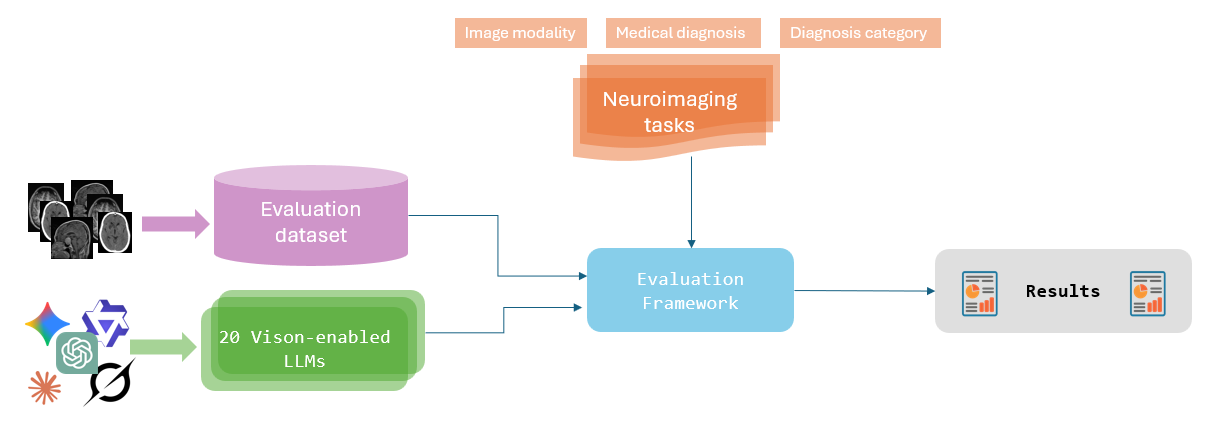
This benchmark evaluates 20 vision-enabled LLMs across MRI and CT neuroimaging tasks,
including diagnosis identification, subtype classification, modality recognition, and anatomical plane detection.
We assess accuracy, calibration, abstention behavior, robustness, and computational efficiency
under a unified, reproducible prompting protocol, comparing zero-shot and few-shot approaches.
What is this benchmark?
- Large-scale evaluation of 20 vision-enabled LLMs (proprietary and open-source)
- Neuroimaging tasks spanning diagnosis, modality, sequence, and anatomical plane
- Diseases include multiple sclerosis, stroke, and brain tumors
- Safety-aware metrics: calibration (ECE, Brier), abstention, and error analysis
- Efficiency and cost evaluation alongside predictive performance
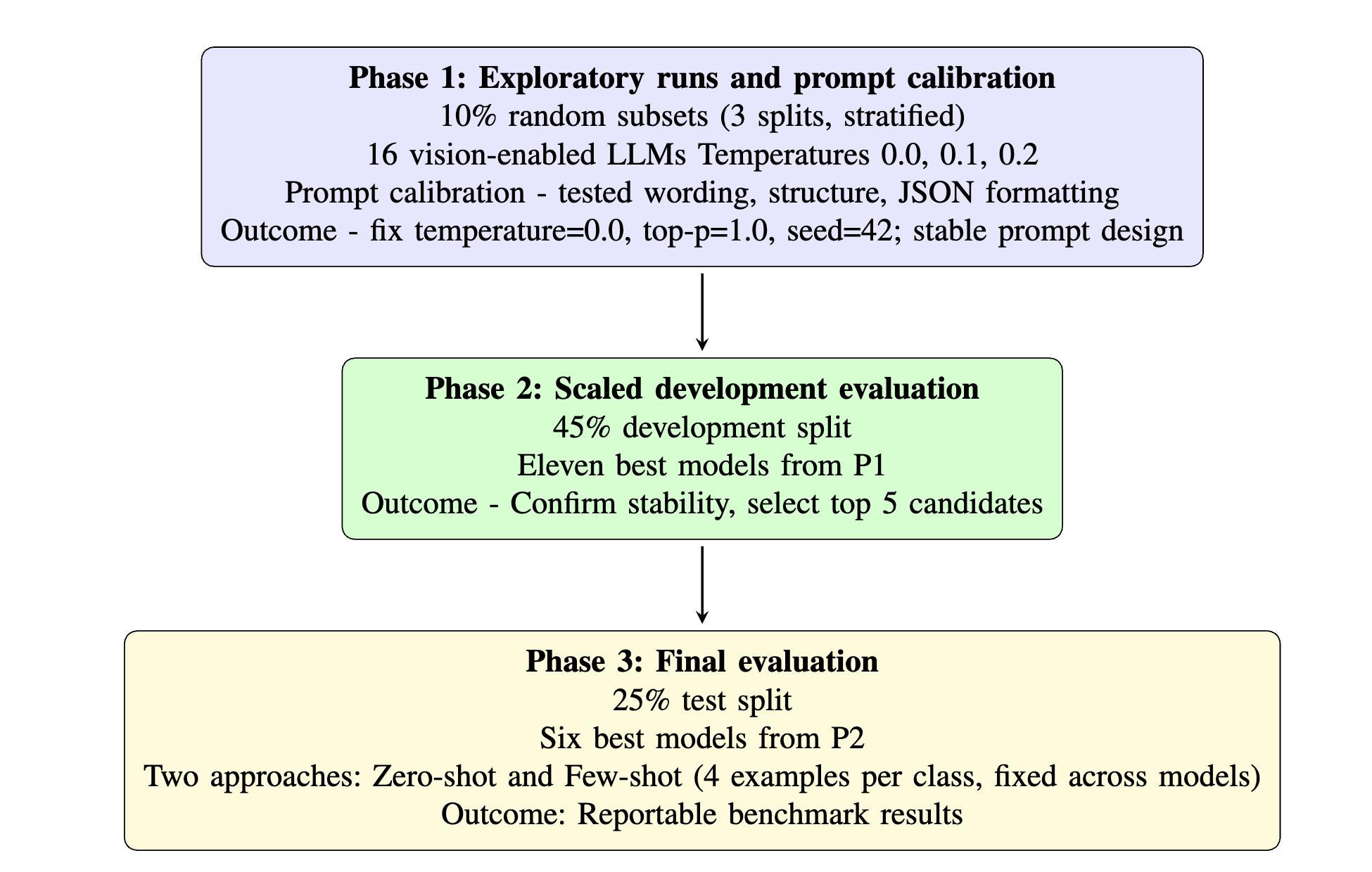
Evaluation protocol
- Phase 1: Prompt calibration on stratified subsets and temperature sweeps
- Phase 2: Scaled development evaluation to select top-performing models
- Phase 3: Final benchmarking using zero-shot and few-shot inference
Funding.
This research is fully funded by the
ChatMed Project,
an EU-funded initiative focused on advancing trustworthy, transparent, and clinically grounded
AI systems for medical decision support.